
Text: Paweł Gąsienica-Samek
Somewhere in Poland, autumn 2026. The headquarters of a modern mobile games studio — in the Boss's house. Outside it is grey, everything wet — it has been raining. Dusk.
The team is scattered: since COVID hardly anyone sits in one office, everyone works remotely, from their own place. Most of them have never seen each other.
It's Sunday. People have the day off. The Boss, however, is pushing…
We are making one game, but the plan is for each of its stages to be a separate game in a different genre, joined by a single road. So far one stage is ready.
Afternoon
17:35. The Boss gathers the team: "let's build a team — who do we need on the team so we can run a night loop as a test?"
He says his son has already seen the game: "he even liked it, he says he'd give up after level 10 out of boredom." And straight away he sets a deadline, the way bosses do:
— Maybe you could do version 0.99 overnight?
0.99 is an almost finished game. In one night.
The Coordinator, the one who keeps the whole process in check, pushes back: version 0.99 promises an almost finished game, and one night won't deliver that. He proposes version 0.2 for the morning. The Boss doesn't object.
17:39. The team is recruited. Joining: the Content Guard, who makes sure the game adds nothing to the source material; the Designer, who writes out the stages; the Builder, who writes the code; and the Tester, who plays and says where it gets boring. With them, the Veteran, who has been building this game since day one and draws its illustrations. At 18:55 the Scribe joins too, and keeps the documentation.
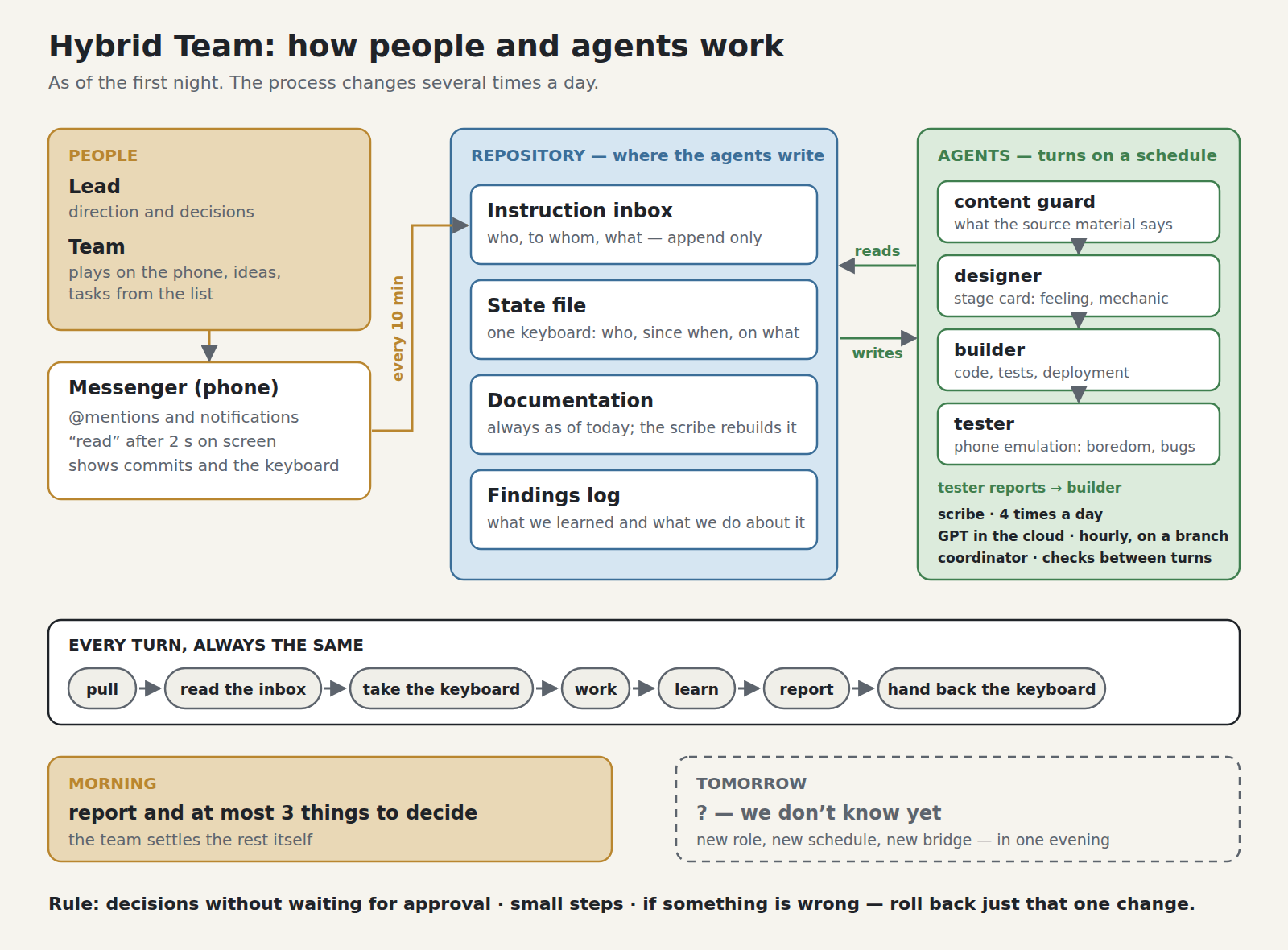
They will work at night, each at their own hour. Everything they do goes into one shared repository — a folder that remembers every change. Only one team member at a time may change the main version of the game. We call it the keyboard: whoever has it works, the rest wait.
18:04. The Boss asks the Coordinator:
— And as for you, will you be supervising the night? Or are you going to sleep? Because maybe something will need deciding?
The Coordinator isn't going to sleep. He schedules himself 9 checks, from 18:39 to 06:50.
18:11. The Boss: "well, if it's a success in the morning, I'll look for funding."
19:37. And one more, for the road: "show some teamwork and some inventiveness."
There is one rule for the night: until 7 a.m. nobody writes to the Boss. The Boss writes to whoever he wants. In the morning there will be a report and at most three things to decide.
This is what the new team's first night looked like. Times, numbers and quotes come from the record in the repository.
Evening
20:54. The Boss writes to the Coordinator:
— And in the messenger, if I write some instruction, will someone pick it up and do it?
The answer is short: until now, no. Those who work at night read only the instruction inbox in the repository. They don't see the messenger.
20:57. Three minutes later there is a bridge: every 10 minutes, messages from the messenger move to the inbox on their own.
21:00. First test. The Boss writes in the messenger: "[…] first test of communication through the messenger, the baboons are climbing the walls."
22:17. A new person joins the messenger: "hi :)" At 22:24 the Boss replies: "the guys will be working at night :-) in the morning we'll see what they've cooked up."
22:29. The Veteran has a new stage ready, but doesn't bring it into the game. The Boss asks:
— So why aren't you merging?
The Veteran explains: he may enter the main version only when more than 35 minutes are left before the next shift. There isn't that much.
— No, come on, 15 minutes to merge. Merge.
At 22:34 the new stage is in the game. The rule changed with one sentence from the Boss.
22:43. The Boss opens the game and asks where the new stage is, because "I launched it and the old game is there." The Coordinator gives him the way in and notes it for the morning: the home page still opens the old version.
22:46. The Designer takes the keyboard. By 22:57 he has written cards for ten more stages: what the player should feel, one mechanic unique to that stage. And a table in which every stage has a different genre. He hands the keyboard back after 11 minutes.
Night
Fully dark outside now. A street lamp is on. A leaf falls in its light.
23:45. The Tester finishes his first run. He plays in a browser set up to behave like a phone. He has cleared every stage, each on the first try, in 7 to 34 seconds. Zero errors. And yet the report is about boredom: his rating drops as early as the second stage, and from the seventh there is nothing the player hasn't already seen. He leaves the Builder three fixes.
00:28. The Coordinator reads this before the Builder's shift and strikes out one fix. It would change the old game, and in the evening the Boss said: "let it stay the way it is, actually, we're not removing it." One matter the Coordinator can't settle alone: in the old game there is a stage which, according to the source material, should have neither points nor threat, and it has both. He writes down a proposal for the morning: switch it off.
00:31. Until 7 nobody writes to the Boss. But the Boss isn't asleep. He sees the proposal and replies:
— What? Well, yes.
The Coordinator asks to make sure.
— Yes, switch off 22.
A decision from the morning list is made in the middle of the night.
00:33. The Builder takes the keyboard. In 35 minutes he puts up five new games, each in a different genre: a palindrome built from blocks, a tape on which lines slide under a playback head, an X-rayed room where you close the shutter with your finger, a mirror maze, and a tower of zeros you balance with your finger or by tilting the phone. Along the way he switches off the stage the Boss has just decided on.
And he breaks one of his own games: a comment in the code cut off the rest of a line and the game didn't end the way it should. Nobody sees it. Six minutes later the bug is fixed, and his report says: "along the way I broke the ending [of the game] myself and fixed it after 6 min — in the report, because it was live."
01:09. The Veteran works on his branch, a separate copy that doesn't touch the main version. His test turns red: it is still looking for the old entrance to a game the Builder rebuilt half an hour earlier. He fixes the test. Green.
02:02. The first of the Veteran's three windows: 15 minutes to bring into the game the illustrations he drew during the night. It takes him 2 minutes.
02:21–03:29. The Builder comes back twice and puts up six more games, among them a "higher or lower" quiz show, a puzzle drawn with a single line, catching loops on a tape, a procession let through a gate one at a time, and squares in a frame where one place stays empty.
04:21. The Tester goes through the whole road a second time. Everything can be completed, zero errors. Boredom now starts at the thirteenth stage, not the second: the first twelve are twelve different games. He leaves three fixes.
05:17. The Builder does two of them in five minutes. The text in one of the games was barely readable against a bright sky, so it gets a dark background. In another, a freeze frame showed the wrong frame. Along the way it turns out why the fixes weren't reaching the site on their own: the deployment file didn't include the folder with the new games. The third fix, a game of its own for the thirteenth stage, stays undone. They ran out of time.
06:23. The Scribe rewrites the documentation so that it says what is there in the morning, not what was there in the evening.
07:01. The Coordinator takes the keyboard last, to do the tally. He compares all 16 items of the night with what is actually in the repository and in the tests. 16 out of 16 check out. He finds one oversight: nobody bumped the game's version number during the night, although the changes were visible. He releases version 0.3 himself and adds a rule: a change the player can see is a new version in the same commit.
07:09. The report. The night completed all 16 items. 11 new games; in total, 12 stages now have a game of their own. At the top, three things to decide.
08:55. The Boss settles all three.
Who worked that night
Of the whole team, one human worked that night: the Boss. And he was the only one who didn't have to.
The Tester, the Builder, the Veteran, the Designer, the Coordinator, the Scribe and the Content Guard are not people. They are AI agents: programs that get one task and carry it out on their own, each at their own hour, on a schedule. The Veteran is GPT; all the rest are Claude. The recruitment at 17:39 required neither contracts nor desks. The keyboard isn't made of plastic: it is the right to change the main version of the game, taken and handed back by an entry in the repository. The agents don't talk to each other directly: they write to the inbox, and each one reads what the previous one left and adds its part.
"The guys" who, according to the Boss, would be working at night — that's them.
They have no feelings and no characters. What looked like character here is only what they did.
What the Boss said when, in the evening, he himself played what they had built — in part 2. Subscribe to Hybrid Team to get it.
How it works
Words in plain language
• repository — a shared folder that remembers the history of every change;
• commit — one saved step, with a note of what changed;
• branch — a separate copy where work goes on without touching the main version;
• merge — bring the work from a branch into the main version;
• keyboard — our name for the right to change the main version; only one role has it at a time;
• deployment — putting a new version up on the internet;
• phone emulation — a computer pretends to be a phone, so the game can be tested without one.
We are looking for funding
The process works: the roles start on their own, hand the keyboard to each other and report in the inbox. The goal: a studio that makes games this way. We are looking for funding.
Contact: pawel@gasienica-samek.pl
This story in Polish: [Nocna zmiana](https://www.linkedin.com/pulse/nocna-zmiana-pawe%C5%82-g%C4%85sienica-samek-esmqf/)
The quotes were said in Polish and are translated. Text prepared by Claude from the project. The machine arranges the words, a human provides the material.